
German Donation Monitor 2025: More Private Donations
On Giving Tuesday, the international day of giving on December 2, 2025, the German Fundraising Association (DFRV), in collaboration with the German Central Institute for Social Issues (DZI), will publish the results of the German Donation Monitor, which is managed by the DFRV. The study is conducted by Bonsai . In 2025, 5,008 people in Germany between the ages of 16 and 75 were surveyed online for this study.
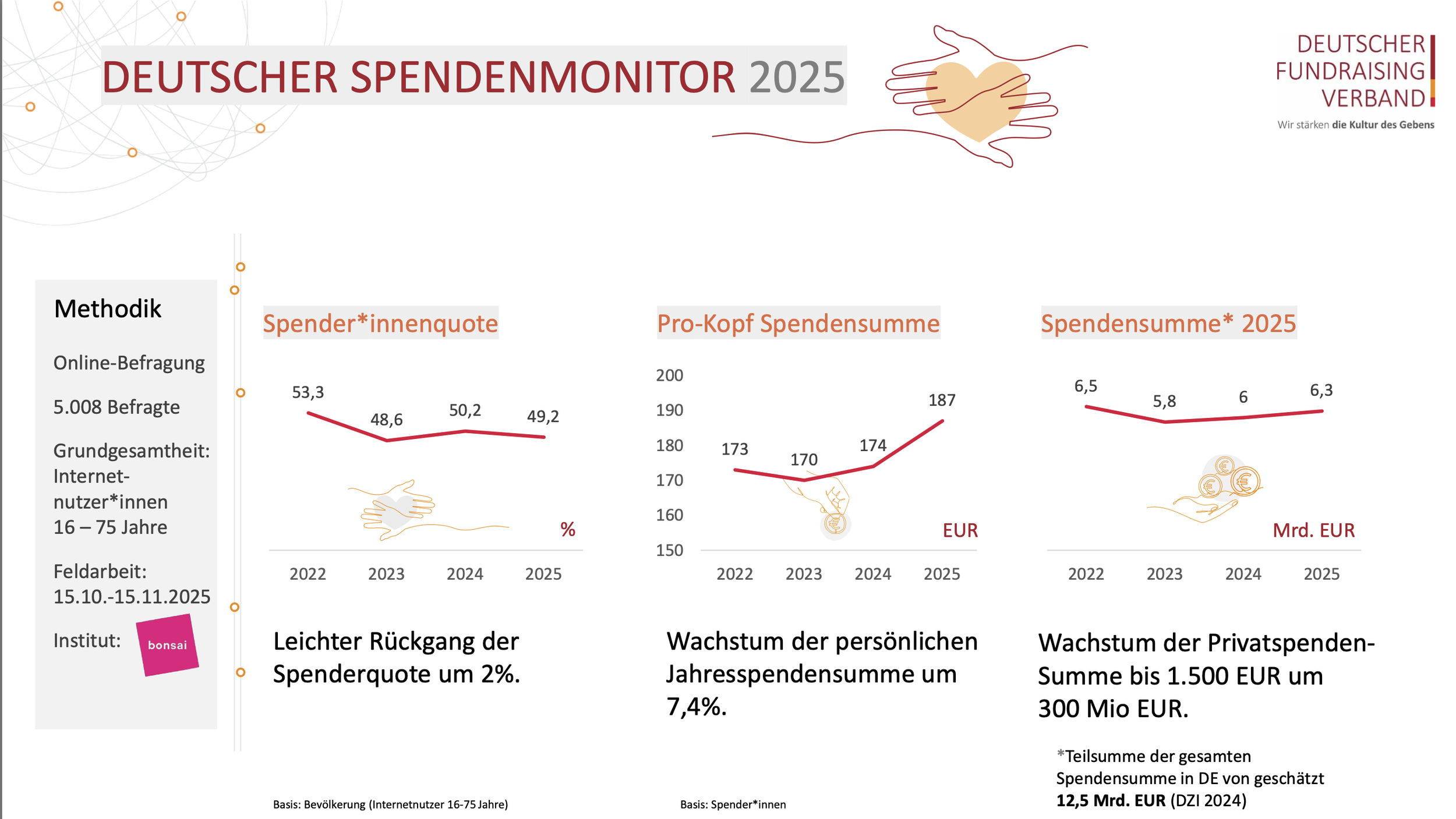
According to the German Donation Monitor, private donations rose by 300 million to 6.3 billion euros (excluding large donations of more than 1,500 euros)
According to the the DZI Donation Index will be 12.5 billion euros.
The donor rate fell slightly from 50.2% to 49.2%.
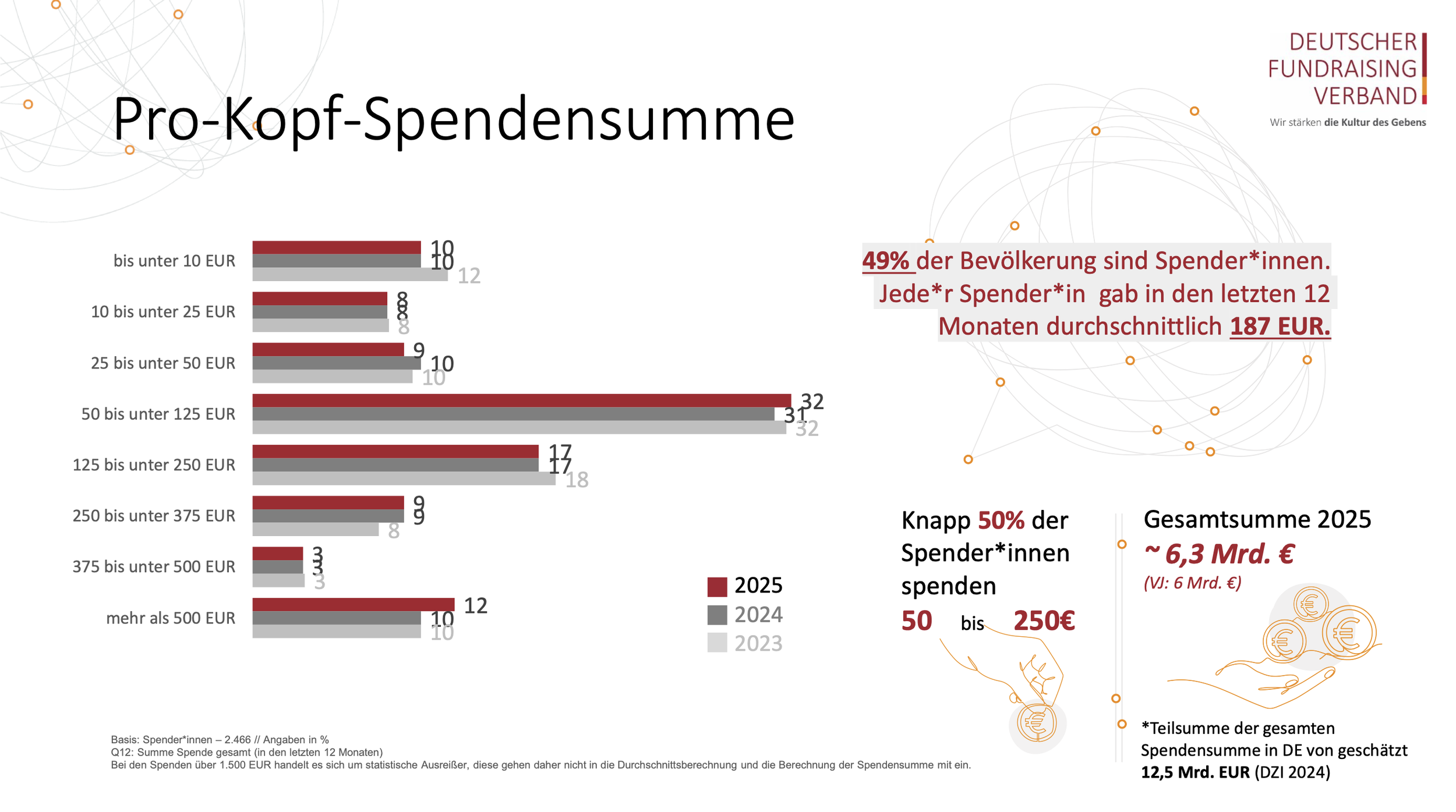
Donors gave an average of 187 euros over the past 12 months, which is an increase of more than 7% compared to the previous year.
41% of people in Germany volunteer.
80% of the population donate in-kind.
The DZI and the German Fundraising Association had already agreed in September 2024 to coordinate their respective surveys, analyses, and publications on giving behavior in order to improve the clarity of donation statistics.
According to the DZI Donation Index, total monetary donations in Germany amount to 12.5 billion euros per year (DZI 2024). Unlike the German Donation Monitor, for example, this figure also includes large donations exceeding 1,500 euros. Charitable organizations have been awaiting this year’s Donation Monitor figures with particular anticipation. Inflation, ongoing multiple crises, and economic uncertainty are making the psychological climate for giving more challenging than usual. Compounding this situation this year was negative media coverage regarding the allocation and use of funding by nonprofit organizations, triggered by a minor parliamentary inquiry from the CDU-CSU parliamentary group. There were fears of a massive crisis of confidence.
“We are pleased that trust in fundraising organizations remains strong. Donors have stayed the course, shown solidarity, and continued to support causes—in some cases with even more funds—despite uncertainties, multiple crises, and rising costs,” says Larissa Probst, Executive Director of the German Fundraising Association.
“Donating is a matter of trust! The stable to slightly positive trend in donations, despite the difficult economic conditions, can therefore also be seen as a result of the significantly improved transparency of many charitable organizations. The increasingly popular services offered by the independent DZI Donation Advisory Service also support people’s willingness to donate, as does modern and responsible fundraising,” says Burkhard Wilke, Managing Director and Scientific Director of the DZI.
Many people want to do good and enjoy the feeling of helping others through their donations and making a lasting impact. As a rule, this requires a catalyst for giving, which often stems from a specific request for donations and active fundraising . Initiatives like Giving Tuesday support this effort . It is important because it gives people who are willing to donate the decisive push they need to get involved and to make that commitment visible.
Key factors in giving are transparency and trust in charitable organizations. Overall, 41% of people in Germany volunteer. Among donors, as many as 53% are also active volunteers and have firsthand insight into the work of these organizations.
About the German Donation Monitor
The German Donation Monitor provides reliable and comparable annual data on the donation market (donor rate, donation amounts, donation purposes, attitudes toward giving) and assesses the awareness and image of participating organizations. In 2025, 5,008 people in Germany between the ages of 16 and 75 were surveyed online. The study is conducted by the market research institute Bonsai GmbH, which is also responsible for, among other things, the 2023 Otto Trend Study—Ethical Consumption and the social media study “Values Index.”