How Artificial Intelligence Is Changing the Donor Market
by Jan Borcherding, Head of Bonsai Public
Jan Borcherding, Head of Bonsai Public
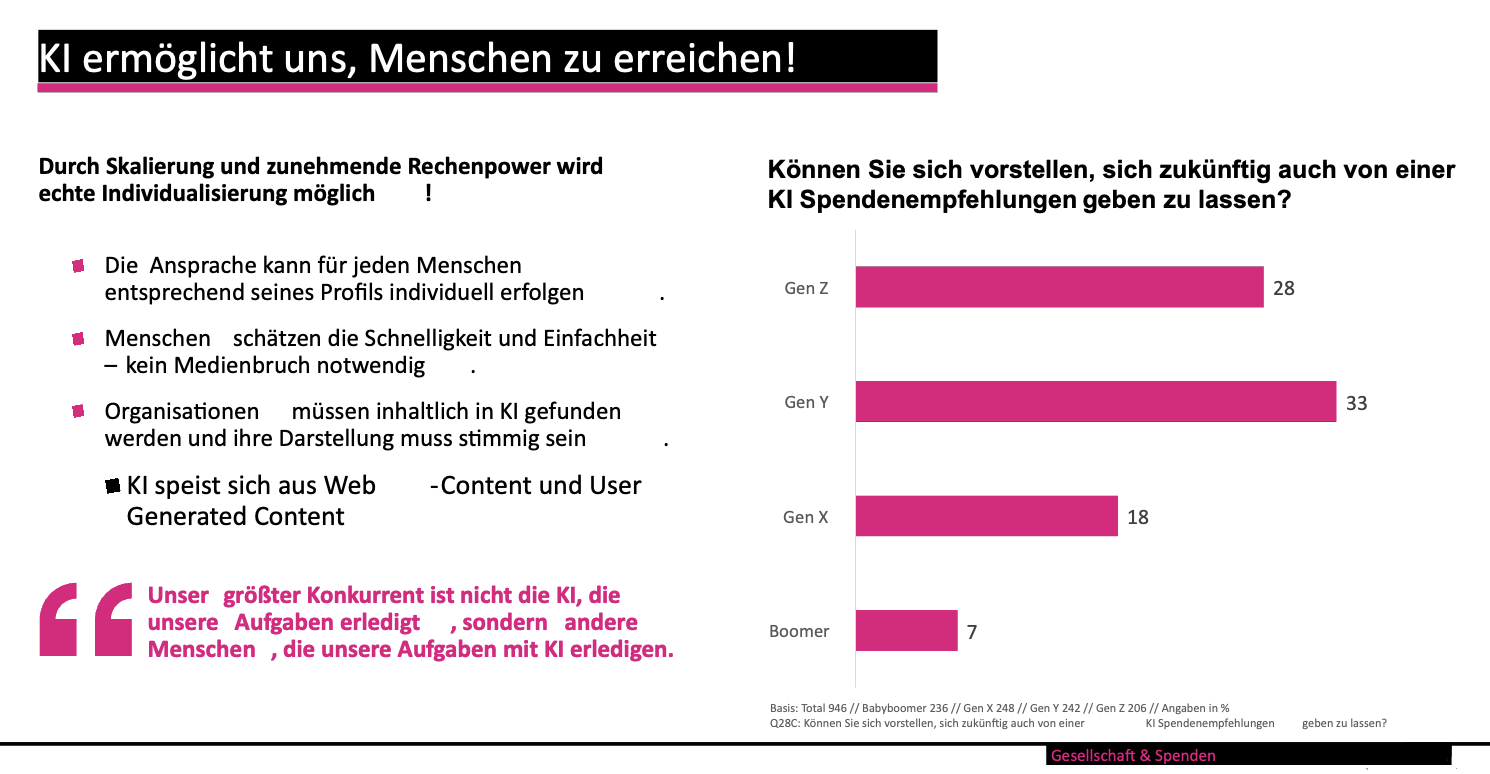
Artificial intelligence is transforming all markets at an unprecedented pace. And AI will also transform one of the most conservative markets—the charitable giving sector—in two ways at once: On the one hand, it threatens to rationalize donation decisions and thereby weaken the very thing that fundraising depends on: emotion. On the other hand, it opens up possibilities for personalization that organizations could only have dreamed of just a few years ago. Both of these trends are already becoming apparent in the German Donation Monitor. And both have one thing in common: they require a much more precise understanding of donors than has been the case so far.
Risk: AI as a Rational Filter
For most people who use it today, AI is primarily a source of information. However, it is increasingly finding its way into everyday applications, such as banking apps and digital household budgets. The younger generation, in particular, has long been conditioned to use such innovations as a matter of course. When managing a household budget, AI makes decisions based not on emotions but purely on numbers. Before a user makes an impulse purchase, it shows whether the purchase still fits within that month’s budget.
The same applies to donations: AI integrated into payment apps objectively shows the user whether a donation is “within budget”—or not.
For organizations, this means their messages must appeal even more strongly to emotions in order to break through this rational filter at all and persuade users to ignore a potential recommendation from the app. And, paradoxically, traditional offline channels—letters, face-to-face conversations, and events—could regain importance. After all, they are the ones that can persuade people to consciously override the recommendation from their AI household budget app—and, in some cases, even enable them to perceive the message at all, since the digital filter has already blocked it outright.
Opportunity: AI as a Tool for Personalization
At the same time, AI enables true, in-depth personalization. Imagine a fundraising letter or email that is no longer written for a generic persona, but for a specific individual. The more the organization knows about that person, the more precisely it can address them. And this applies not only to digital channels, but—with effective personalization of mailings—to the offline world as well.
Where We, as Market Researchers, Come In
At first glance, these two trends seem to be opposites. In fact, they both revolve around the same question: What truly motivates a person to donate—at what moment and through which channel? This is precisely where we, as market and opinion researchers, can make a significant contribution—on three levels.
Making emotions measurable. Which messages, images, and proposed solutions actually get past the rational filter? This can’t be guessed—it must be tested—using ad pre-tests, A/B designs, and in-depth qualitative interviews before the budget is allocated to a campaign.
Finding the Right Channel. When is a letter more effective than an email, and when is a phone call more effective than an ad? Long-term data, such as that from the Donation Monitor, shows how channel preferences are shifting and where offline channels are finding their new place.
Building the Data Foundation for Personalization. AI is only as good as the knowledge it works with. And personalization requires more than just transaction data. Motives, values, life stages, and triggers—such as starting a career, starting a family, retirement, or a major life crisis—can only be reliably captured through surveys and analysis. Segmentation and donor typologies derived from research provide the foundation upon which AI-supported outreach can be meaningfully built.
Conclusion
AI doesn't relieve organizations of the need to think about and understand their donors—it makes it more urgent. Anyone who wants to break through the rational logic of AI while also harnessing its potential for personalization needs both: a deep understanding of emotions and a robust database.
Market research is not an adversary of AI, but rather its most important partner. After all, the biggest competitor isn’t AI itself, but the organization that knows its donors better.